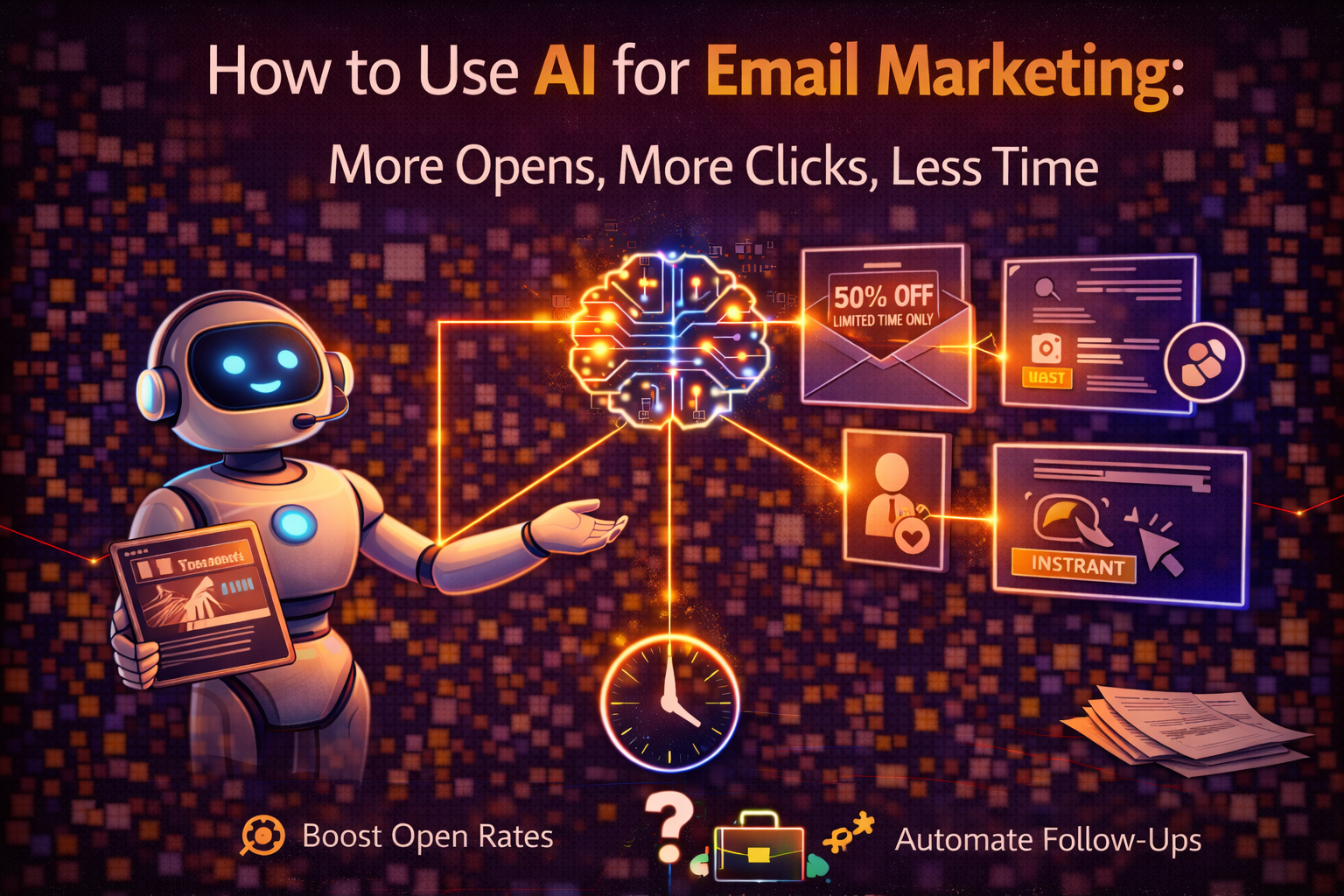
Email marketing has a reputation problem that the numbers don’t entirely support. Ask most small business owners how they feel about their email marketing and you’ll hear some combination of guilt — they know they should be sending more consistently — frustration — the time required to produce good emails exceeds what they have available — and skepticism — they’re not sure the emails they do send are actually doing anything useful for their business.
The numbers tell a different story. Email consistently produces higher return on investment than any other digital marketing channel, including social media, paid advertising, and content marketing. The businesses that send consistently, that write emails people actually want to read, and that use their list strategically generate revenue directly from those emails in ways that are measurable and often surprising relative to the effort involved. The problem isn’t email marketing as a channel. It’s the gap between what effective email marketing requires and what most small businesses have the time and skill to produce.
AI tools close a significant portion of that gap. Not by replacing the strategic thinking about what to send and why, but by dramatically reducing the time required to go from that thinking to finished, sent emails. Subject lines that took thirty minutes of deliberation can be generated and tested in five. Email drafts that took two hours can be produced in twenty minutes. Sequences that would have required a week to map and write can be built in an afternoon. The channel that was genuinely valuable but genuinely time-consuming becomes genuinely valuable and genuinely manageable.
The Subject Line Problem and How AI Solves It
Subject lines are where most email marketing time gets wasted and where the impact on performance is highest. Open rates — the percentage of recipients who open an email — are almost entirely determined by the subject line and the sender name. Everything else in the email is irrelevant if the subject line doesn’t earn the open.
Most business owners approach subject line writing the same way: stare at the email, think about what it’s about, write a description of the content. “June Newsletter,” “Update From Our Team,” “New Product Launch.” These subject lines are accurate and completely forgettable. They don’t create curiosity, don’t promise a specific benefit, don’t create any reason for the reader to open now rather than later — which in email marketing means never.
AI tools generate subject line variations quickly and can be directed toward the specific psychological mechanisms that drive opens. A prompt that works well: “I’m sending an email to my customer list about [topic]. The most important thing in the email is [key point or offer]. Generate fifteen subject line variations that approach this from different angles — curiosity, specific benefit, urgency, social proof, question format, and direct statement. For each one, note what psychological mechanism it’s using.”
The output gives you options to evaluate rather than blank-page pressure to generate from scratch. Review them with two questions: which ones would make me open this email if I received it, and which ones accurately represent what’s inside. Subject lines that generate opens through misleading promises create the worst outcome in email marketing — high open rates followed by immediate unsubscribes and damage to the trust your list has in your emails.
Test subject lines whenever your list is large enough to produce statistically meaningful data — most email platforms support A/B testing subject lines on a portion of your list before sending the winning version to everyone. Over time, the subject lines that consistently generate opens for your specific audience become the templates you use as starting points rather than generating from scratch each time.
Writing Emails People Actually Read
The structural problem with most business emails is that they’re written from the sender’s perspective rather than the reader’s. The sender knows what they want to communicate and organizes the email around that. The reader opens every email asking the same question: what’s in this for me? When the email doesn’t answer that question in the first two sentences, it gets closed and the reader moves on.
AI tools produce emails with the same structural problem when given generic prompts — they default to a structure that covers the topic logically from the sender’s perspective rather than opening with the reader’s interest. Getting AI to produce emails that hold attention requires giving it specific direction about the reader’s perspective first.
The prompt structure that produces better email drafts includes: who the reader is and what they care about, what they were probably thinking or experiencing before they opened this email, what the most important thing you want them to know or do is, and what benefit or value they receive from reading and acting. With those inputs, the AI can open the email from the reader’s perspective rather than the sender’s.
A practical approach for a promotional email: “Write an email to my customer list announcing a 20% discount on our annual subscription. My customers are small business owners who are time-stretched and cautious about spending. Before opening this email they were probably skeptical about whether it’s another discount offer trying to push them into a commitment. Open the email by acknowledging that they’ve probably received a lot of offers like this, then quickly distinguish why this one is different and worth reading. Keep it under 200 words and end with a single clear call to action.”
The instruction to open by acknowledging the reader’s likely skepticism is the kind of specific direction that produces an email that feels like it was written by someone who understands the reader rather than by someone who wants something from them. That distinction is what drives engagement.
Building Email Sequences That Do the Work Automatically
Single emails require consistent effort to maintain regular communication. Email sequences — automated series of emails triggered by a specific action like joining a list, making a purchase, or signing up for a trial — do the communication work automatically once they’re built, and they represent one of the highest-leverage investments in email marketing available to small businesses.
The most valuable sequences for most small businesses are a welcome sequence for new subscribers, an onboarding sequence for new customers, and a re-engagement sequence for subscribers who have stopped opening emails. Each serves a different purpose and reaches people at a different stage of their relationship with your business.
A welcome sequence introduces new subscribers to your business, establishes the value of being on your list, and begins building the relationship that eventually leads to a purchase. A five-email welcome sequence spread over two weeks — introducing your business and its perspective on day one, sharing a useful piece of content on day three, telling a customer story on day five, presenting your main offer on day eight, and following up with a softer second offer on day twelve — provides a structured introduction that converts more new subscribers into customers than a single welcome email.
Building this with AI involves two phases. First, ask your AI tool to map the sequence strategy — how many emails, what each covers, what the goal of each email is, and how they connect to each other. Review and adjust this map before writing a word. Second, write each email individually using specific prompts that include the stage in the sequence, what came before, what the reader knows and feels at this point in the relationship, and what you want them to do or feel after reading.
The sequence mapping phase is often skipped when people use AI for email sequences — they jump directly to writing individual emails without establishing how they fit together. The resulting emails are individually adequate but strategically disconnected, which produces lower overall conversion than a sequence where each email is written with explicit awareness of where the reader is in the relationship.
Personalization That Goes Beyond First Names
Email personalization has been dominated for years by first name insertion — “Hi [First Name]” — which has become so ubiquitous it registers as automation rather than personalization. Real personalization in email marketing means content that’s relevant to the reader’s specific situation, behavior, or interests rather than simply addressing them by name.
AI tools enable a level of personalization that was previously available only to businesses with dedicated marketing operations by making it practical to create multiple versions of emails tailored to different segments of a list. A business with customers at different stages — new customers, customers who’ve been around for a year, customers who haven’t bought recently — can create emails that acknowledge each group’s specific situation rather than sending identical content to everyone.
The practical approach is to identify your two or three most meaningful customer segments — defined by purchase history, engagement level, or whatever dimension matters most for your business — and ask your AI tool to write a version of each email for each segment. Give it the core message and the segment description, and ask it to adapt the opening, the examples used, and the specific benefit emphasized to resonate with that segment’s situation.
The additional time required for segmented emails is modest when AI is doing the drafting — the incremental time to produce three versions rather than one is minutes rather than hours. The improvement in relevance and engagement is significant because readers who receive content that reflects their specific situation respond to it at higher rates than readers who receive generic content.
Reactivating Cold Subscribers
Every email list contains subscribers who haven’t opened an email in months. These cold subscribers represent unrealized value — they joined for a reason, they’re still on the list, but something disconnected them from the content. Before writing them off or removing them, a well-constructed re-engagement sequence gives them a reason to reconnect.
Re-engagement emails are one of the use cases where AI assistance is most directly valuable because the writing challenge is specific and counterintuitive. The instinct is to remind cold subscribers what they’re missing — here’s what we’ve been sending, here’s what you’ve overlooked. The approach that actually works acknowledges the disconnect directly and gives a compelling reason to re-engage, without pressure and without pretending the gap didn’t happen.
A prompt that produces effective re-engagement emails: “Write a re-engagement email for subscribers who haven’t opened any of my emails in the past four months. My list is [describe your list and what you normally send]. The email should acknowledge that they haven’t heard from me in a while without being passive-aggressive about it. It should offer a compelling reason to re-engage — either a specific valuable piece of content or a relevant offer — and make it easy to either re-engage or unsubscribe. The tone should be warm and no-pressure. Keep it under 150 words.”
The instruction to make it easy to unsubscribe is deliberate and counterintuitive. Re-engagement sequences that try to hold onto subscribers through friction produce lists with low engagement and damaged deliverability. Subscribers who don’t want to be there hurt your sender reputation — email platforms measure engagement rates and low engagement results in emails being filtered to spam for everyone on your list, not just the cold subscribers. Cleaning your list regularly through re-engagement sequences that make unsubscribing genuinely easy actually improves the performance of your emails to the subscribers who do want to hear from you.
The Newsletter That People Look Forward To
Most business newsletters are sent because someone decided sending a newsletter was a good idea, contain whatever information was available that week, and are read by a declining percentage of subscribers over time as the content fails to consistently deliver enough value to justify the inbox space.
A newsletter people look forward to is built around a consistent promise — a specific type of value that readers can rely on receiving — and delivered consistently enough that readers develop a habit of opening it. The promise can be almost anything: weekly practical tips on a specific topic, a curated selection of the most useful content in your industry, a behind-the-scenes look at how you run your business, a weekly analysis of a trend affecting your customers. What matters is that the promise is specific enough to create genuine anticipation and consistent enough to build the habit.
AI tools assist newsletter production most effectively when the format is established and repeatable. A newsletter with consistent sections — a short observation, a practical tip, a resource recommendation, a brief update from the business — can be drafted quickly with AI once the format template is built. The template structures the prompt, the AI drafts the sections, and your job is to inject the specific examples and perspective that make each issue worth reading.
The time investment to produce a consistently valuable newsletter drops from two hours to thirty minutes when AI is doing the drafting work and the format is established. That’s the difference between a newsletter that gets published every week and one that gets published when there’s time.
Measuring What’s Working and Improving Over Time
The metrics that matter for email marketing are open rate, click rate, and conversion rate — the percentage of recipients who opened, clicked a link, and took the desired action. Most email platforms track the first two automatically and the third requires some setup depending on what conversion means for your business.
Sharing this data with your AI tool periodically and asking it to identify patterns — which subject line approaches produce the best open rates for your list, which types of content generate the most clicks, which calls to action produce the best conversion — produces actionable insights faster than manual analysis. More importantly, asking the AI to suggest specific tests based on the patterns it identifies gives you a structured improvement process rather than intuition-based guessing about what to try next.
Email marketing improves through iteration more reliably than almost any other marketing channel because the feedback loop is fast — you send an email, you know the results within 48 hours, you apply what you learned to the next email. AI tools make the testing and iteration cycle faster by reducing the time required to produce variations and analyze results. The combination of fast feedback and efficient production is what makes email marketing compound in value over time for businesses that approach it systematically.
→ Read next: How to Build an Entire Content Strategy Using AI in One Afternoon
Currently sending emails to your list but not happy with the results, or not sending at all because the production feels too time-consuming? Leave a comment with where you’re stuck and we’ll give you a specific recommendation for your situation.
Leave a Reply