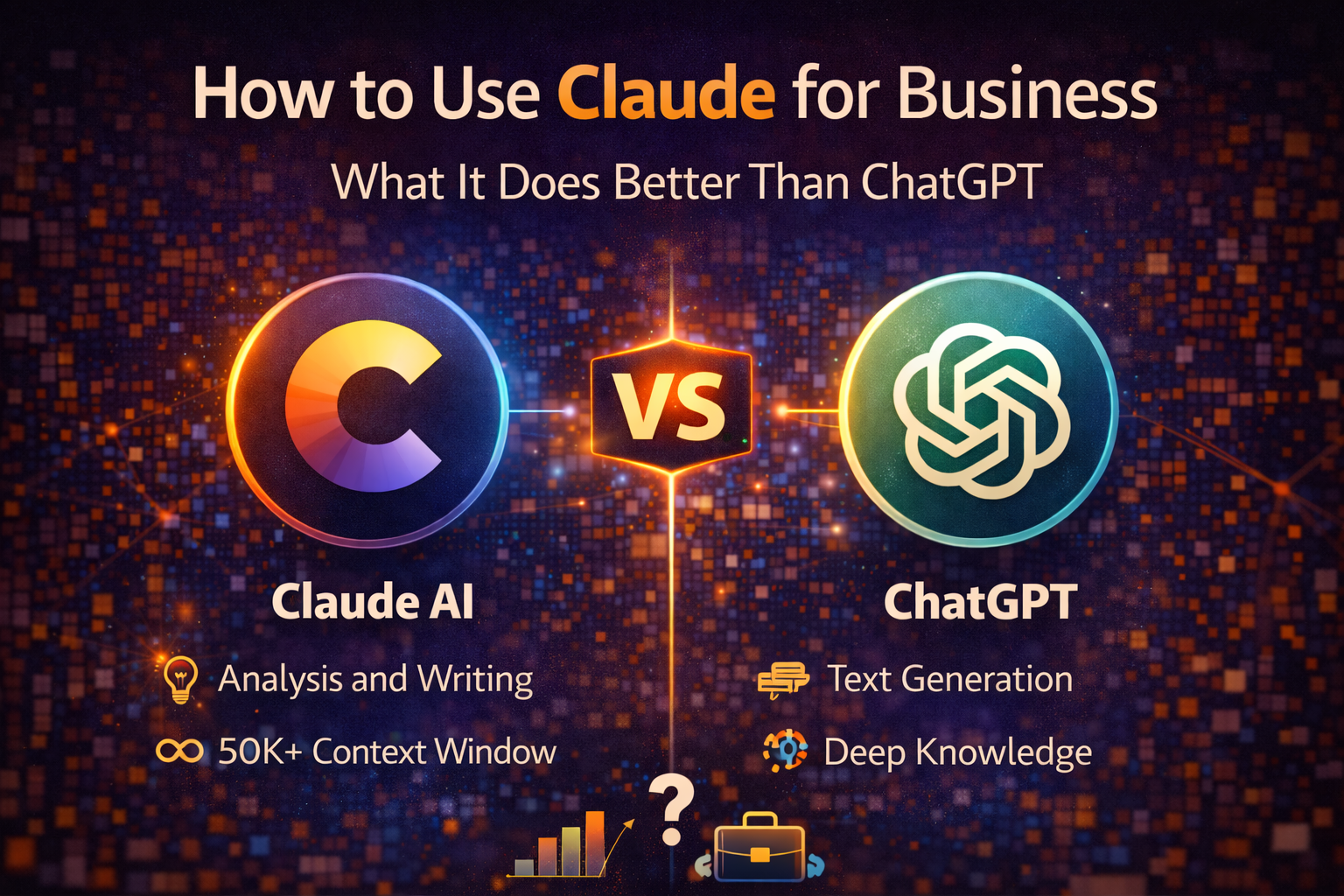
I used ChatGPT exclusively for about eight months before a specific frustrating experience pushed me to test Claude seriously. I had asked ChatGPT to critically evaluate a client proposal I was about to present — something I was genuinely uncertain about and needed honest feedback on. The response I got back was warm, encouraging, and almost completely useless. It acknowledged the strengths at length, offered mild suggestions framed as minor enhancements, and left me feeling good about a proposal that, as I discovered in the actual presentation, had two significant structural problems that a genuinely critical review would have caught.
I ran the same proposal through Claude the same afternoon. The feedback was uncomfortable to read and exactly what I needed. It identified the structural problems directly, pushed back on an assumption I had treated as established, and gave me the specific objections the client was likely to raise. I fixed both issues before the next presentation. That single experience shifted how I think about when to use each tool — and the shift has produced better work consistently since.
The Design Difference That Explains the Performance Difference
Understanding why Claude performs differently from ChatGPT on specific tasks requires a brief explanation of what each tool is actually optimized for — because the differences aren’t random and knowing the reason makes the pattern predictable rather than surprising.
ChatGPT is optimized broadly for usefulness across the widest possible range of tasks. The design prioritizes user satisfaction at scale — which in practice means producing confident, complete, agreeable responses even in situations where more uncertainty or more pushback would be more accurate. This is a reasonable design choice for a consumer product serving hundreds of millions of users with varied needs. It produces a tool with impressive breadth and an ecosystem of integrations that no competitor currently matches.
Claude is optimized with a specific emphasis on honesty and what Anthropic calls constitutional AI — a training approach designed to make the model’s behavior consistent with a defined set of values rather than purely optimized for approval ratings. In practice this produces a tool that is more likely to acknowledge uncertainty, more likely to push back on flawed premises, and — in areas directly related to language quality — more likely to produce output that sounds like it was written by a thoughtful human rather than a capable machine.
These are not just philosophical differences. They produce specific, observable, consistent differences in output quality for the categories of tasks that matter most for business use.
Long Document Analysis: The Advantage Nobody Talks About Enough
The most practically significant technical difference between Claude and ChatGPT for business users is context window size and — more importantly — how effectively each model actually uses a large context.
I tested this directly with a fifty-page client contract. I uploaded it to both tools and asked specific questions about content that appeared in the early sections after the conversation had progressed through the later sections. Claude maintained accuracy throughout. ChatGPT began losing track of early content as the conversation grew longer — producing plausible-sounding answers that were either imprecise or subtly wrong when checked against the actual document.
For business tasks that involve processing long documents — contracts, research reports, financial documents, lengthy proposals, comprehensive strategy documents — this difference is material in practice. Claude reads and reasons about long documents as coherent wholes, identifying connections between sections, noticing inconsistencies, and answering specific questions about content anywhere in the document without losing the context established earlier.
The prompt that leverages this most effectively: ask Claude to read the entire document carefully before responding to any questions, and for each answer to identify which part of the document it is drawing from. The instruction to cite the source makes it immediately obvious whether Claude is accurately drawing from the document or generating plausible responses from general knowledge. In my experience, Claude passes this test consistently on long documents. ChatGPT passes it less consistently as documents get longer.
For anyone who regularly works with contracts, detailed proposals, or comprehensive research documents, this capability difference alone justifies routing those tasks to Claude rather than ChatGPT.
What Most People Get Wrong About Claude vs ChatGPT
The most common mistake is treating this as a question with a single answer — one tool is better, case closed. The comparison that actually helps business users is not which tool is objectively better but which tool is better for which specific tasks, because the answer to that question is actually useful for deciding which one to open.
The second mistake is evaluating Claude’s writing quality on the wrong type of task. Running a quick factual query through both tools and comparing the outputs doesn’t reveal the writing quality difference that matters for business content. The difference shows up on tasks where voice authenticity matters — brand storytelling, thought leadership, executive communications, customer-facing content that needs to build a relationship rather than just convey information. Run the same content brief through both tools on one of those tasks and read the outputs side by side. The ChatGPT version is typically competent and complete. The Claude version is typically more interesting — the sentences don’t fall into the same rhythmic patterns, the word choices are more varied, the voice has more character.
The third mistake — and this is the one that cost me the most before I figured it out — is using ChatGPT when you need genuine critical feedback. ChatGPT’s sycophancy is well-documented and real. If you present a business plan to ChatGPT and ask for critical feedback, you will receive a response that validates your thinking, acknowledges strengths at length, and offers mild suggestions framed as enhancements. You will feel good about your plan. You will not necessarily have a better plan.
Claude is more likely to tell you what is actually wrong — to identify significant problems rather than minor improvements, to push back on flawed assumptions rather than work within them, and to give you the feedback that is useful rather than the feedback that is comfortable.
Writing Quality: The Difference That Compounds Over Time
The writing quality difference between Claude and ChatGPT is the most subjective comparison in this post and also the most consistently reported by professional writers and content marketers who produce significant content volume. Claude’s output tends toward more varied sentence structure, more natural rhythm, fewer of the tells that mark AI-generated content as obviously AI-generated, and a quality of voice that reads as more distinctly human.
For business content where brand voice matters, this translates into content that requires less editing before it feels genuinely representative of the brand. The time saved in editing across a significant content volume is meaningful. More importantly, the content that reaches customers is better — which produces compounding effects on perception and engagement that are difficult to measure individually but real over time.
The tasks where Claude’s writing quality advantage is most pronounced are the ones where voice authenticity matters most: thought leadership content where the writing needs to reflect an individual’s perspective and credibility, brand storytelling where the content needs to create an emotional connection, and customer communications where the tone affects the customer’s confidence in the relationship.
Honest Feedback: The Use Case That Changed How I Work
The experience I described at the start of this post — needing genuine critical feedback and getting validation instead — is not an edge case. It is one of the most common and most costly ways that AI tools fail business users who don’t know which tool to use for which task.
Before presenting any proposal, strategy, or business plan to an important audience, I now run it through Claude with a specific prompt: identify every significant weakness, questionable assumption, missing element, and potential objection. Be direct and don’t soften the feedback. I need to know what is actually wrong with this before I present it.
The feedback from that exercise is consistently more useful for improving the document than a balanced review that emphasizes strengths and weaknesses equally. The discomfort of reading genuinely critical feedback is the point — it is what makes the feedback actionable rather than encouraging.
The same approach works for argument construction — asking Claude to steelman the opposing position on a business decision, to identify the best case against the strategy you are planning to pursue, or to anticipate the most damaging objections a critic or competitor could raise. This kind of adversarial thinking is where Claude’s honest orientation produces the most distinctive value relative to tools that default toward agreement.
Coding and Technical Tasks: A More Honest Picture
The comparison on technical tasks is more nuanced than on writing and analysis. ChatGPT’s code generation is strong and reliable for common programming tasks. Claude’s code generation is competitive on quality and, according to developers who use both regularly, tends to produce code that is more readable, better commented, and more thoughtfully structured.
For business users without technical backgrounds who need AI assistance with technical tasks, Claude’s explanatory quality is the more important factor. An AI tool that produces working code and explains clearly what it does and why is more useful for non-technical business owners than one that produces equivalent code with less explanation. Claude consistently explains its technical output in ways that non-technical users can evaluate and learn from.
When to Use Claude and When to Use ChatGPT
The task allocation that produces the best results is straightforward once the core differences are understood.
Use Claude when writing quality and voice authenticity matter — brand content, thought leadership, executive communications, customer-facing writing that needs to sound distinctly human. Use Claude for long document analysis where maintaining context across the full document is critical. Use Claude whenever you need honest feedback rather than validation — strategy review, argument stress-testing, critical evaluation of plans before they reach important audiences.
Use ChatGPT when ecosystem breadth matters — integrations, custom GPTs from the public library, DALL-E image generation, Advanced Data Analysis for spreadsheet work where code execution is the key feature.
For most business users, the optimal setup is not choosing between the two but using each where it performs best. Both offer free tiers adequate for evaluating which tasks benefit from each. Both offer paid tiers at the same price point for users whose volume justifies the subscription. The business that figures out the routing — Claude for writing quality and honest analysis, ChatGPT for ecosystem breadth and data work — gets more from both tools than the business that picks one and uses it for everything.
Claude and ChatGPT are two tools in a broader AI productivity stack that serious business users are building in 2026. Our comparison of the best AI tools for business productivity covers the full stack — research, writing, design, and automation — with the same hands-on evaluation approach this guide applies to the Claude versus ChatGPT comparison specifically.
→ Related: ChatGPT vs Claude vs Gemini: Which AI Tool Is Actually Best for Your Business
Leave a Reply